Electronic
Device Applications
Toward utilizing the composite in the nanoscale, the following device concepts have been established and the real devices are underway: One is utilizing the conductivity change with the change of applied magnetic field, the phenomena is called Giant Magnetoresistance (GMR). The final goal is to obtain a GMR sensor with a flexible polymer matrix.
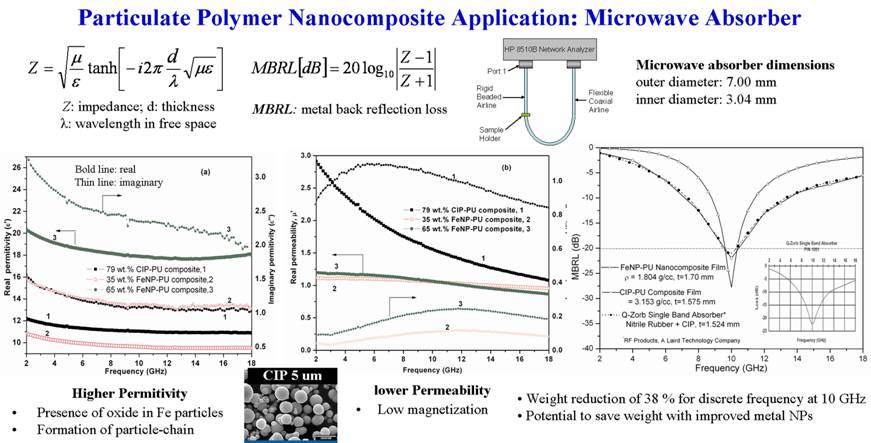
The other is electromagnetic wave absorption, which is utilizing the active microwave absorption component in the polymer nanocomposite with filler size smaller than the skin depth. The purpose is to reduce the device weight.
1) Giant
Magnetoresistance (GMR)
Advantage of Polymer Nanocomposite Sensor
· Easy fabrication
· Light-weight
· Stability
· No need for extra package
· Ready to be used in biomedical engineering
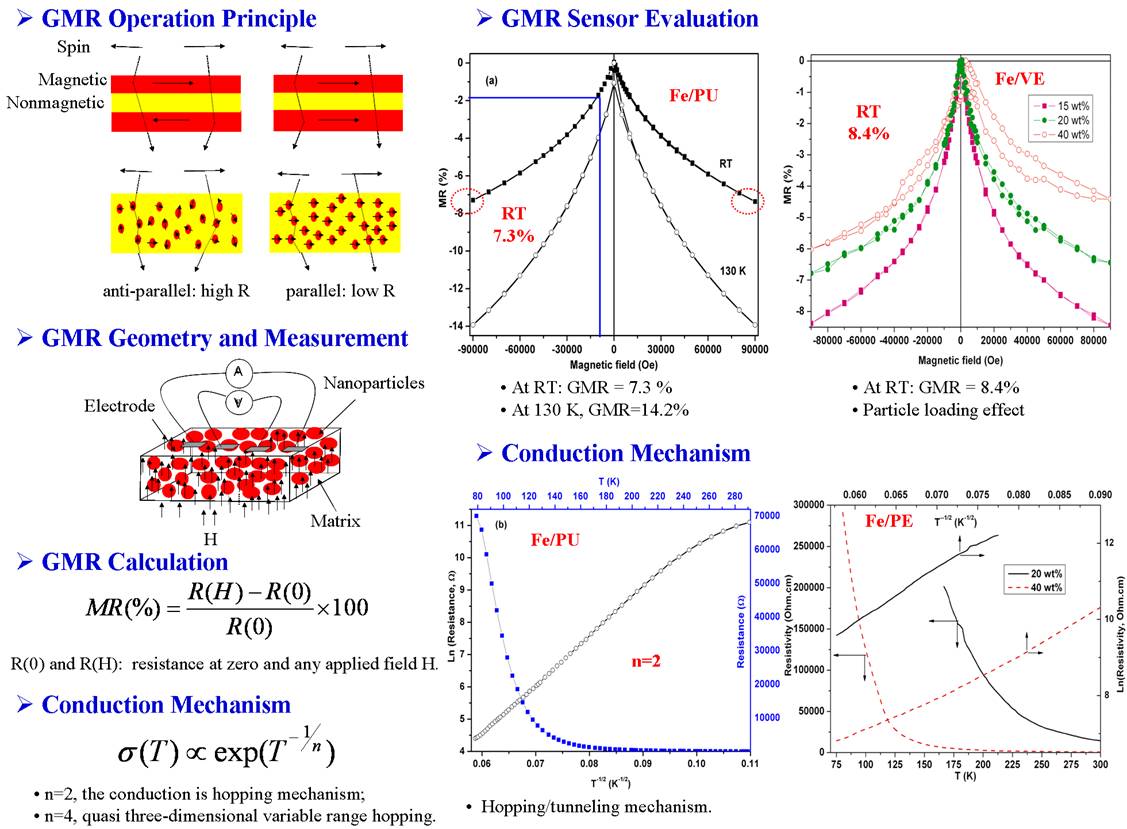
Challenge: to achieve the GMR sensor with high sensitivity.
Possible resolution: particle size, particle distribution
and particle loading.
2) Microwave
Absorption
References:
 “Magnetic and Magnetoresistance
Behaviors of Solvent Extracted Particulate Iron/Polyacrylonitrile
Nanocomposites” D. Zhang; R. Chung; A. B. Karki; F. Li; D. Young; Z. Guo* Journal of Physical Chemistry C, 114, 212-219 (2010) [pdf linkage]
“Magnetic and Magnetoresistance
Behaviors of Solvent Extracted Particulate Iron/Polyacrylonitrile
Nanocomposites” D. Zhang; R. Chung; A. B. Karki; F. Li; D. Young; Z. Guo* Journal of Physical Chemistry C, 114, 212-219 (2010) [pdf linkage]
“Magnetic
and Magnetoresistance Behaviors of Particulate Iron/Vinyl Ester Resin
Nanocomposites,” Z. Guo; H. T. Hahn; H. Lin; A. B. Karki and D. P.
Young, Journal of Applied Physics, 104, 014314 (2008). [pdf linkage]
“Fabrication, Characterization and Microwave
Properties of Polyurethane Nnaocomposites Reinforced with Iron Oxide and Barium
Titanate Nanoparticles” Z. Guo*; S. E. Lee; H. Kim; S. Park; H. T.
Hahn; A. B. Karki; D. P. Young, Acta
Materialia, 57, 267-277 (2009).
[pdf
linkage]
“Giant
Magnetoresistance Behavior of An Iron/Carbonized Polyurethane Nanocomposite,”
“Magnetoresistance
and Annealing Behaviors of Particulate CoAu Nanocomposites,”
“Magnetic
and Electromagnetic Evaluation of the Magnetic Nanoparticle Filled Polyurethane
Nanocomposites,”